Feynman Project at GreenPolicy360
May 2026
"We are children of the Earth" -- Richard Feynman, Physicist/Educator
A Feynman Project
We are revisiting the work, the words, the teaching and the learned life lessons of a professor, a genius, an environmentalist (in the deep meaning of ecology), a true character and 'planet citizen' of our era. Say quantum, picture diagrams scribbled on a green chalkboard, listen to a Nobel prize winner perform before a Caltech class being led into wonderment and waves of insight -- say Richard Feynman.
We had a chance to visit elements of his personal collection. His work needs to be scanned and digitized, and made available online as a Special Collection.
We're making this a project.
It is time.
🌎
○ “I have a friend who's an artist and has sometimes taken a view which I don't agree with very well. He'll hold up a flower and say "look how beautiful it is," and I'll agree. Then he says "I as an artist can see how beautiful this is but you as a scientist take this all apart and it becomes a dull thing," and I think that he's kind of nutty. First of all, the beauty that he sees is available to other people and to me too, I believe. Although I may not be quite as refined aesthetically as he is ... I can appreciate the beauty of a flower. At the same time, I see much more about the flower ... I could imagine the cells in there, the complicated actions inside, which also have a beauty. I mean it's not just beauty at this dimension, at one centimeter; there's also beauty at smaller dimensions, the inner structure, also the processes. The fact that the colors in the flower evolved in order to attract insects to pollinate it is interesting; it means that insects can see the color. It adds a question: does this aesthetic sense also exist in the lower forms? Why is it aesthetic? All kinds of interesting questions which the science knowledge only adds to the excitement, the mystery and the awe of a flower." -- Richard P. Feynman, The Pleasure of Finding Things Out
GreenPolicy360: Speaking of a flower, beauty, and science -- let us take a moment for an aside, a reveal, a journey into GreenPolicy360, About Us, our sunflower-branded Mediawiki platform, and big-picture thoughts on 'how flowers changed the world' ... aesthetically and practically, imaginatively and scientifically....

Let us begin with a Creative Commons sharing of a visionary scientist, Loren Eisely. A modest man who, in our way of seeing, is another "planet citizen" who could see far beyond what most of us see...
'How flowers changed the world on Planet Earth', yes, a shared Immense Journey...

Now Onto Another Immense Journey, This with Grapes ;-)
Now we think about nectar and sweetness of wine, and a Richard Feynman story shared with us. Here, listen in as if Richard is speaking of physics and the universe, and a glass of red vintage wine...
(The following story comes to us courtesy of Richard via 'Enlightening Facts')
It was 1961. Caltech had invited Richard Feynman to teach introductory physics to undergraduates.
Feynman didn't lecture like other professors. He didn't drone on about formulas or fill blackboards with equations that only confused students. Instead, he did something different.
He made physics human.
One lecture would become legendary. It was titled "The Relation of Physics to Other Sciences," and it began with Feynman quoting a poet.
"The whole universe is in a glass of wine."
He paused. Smiled that mischievous smile his students would come to recognize. And said: "We will probably never know in what sense he meant that, for poets do not write to be understood."
The lecture hall laughed. But then Feynman got serious.
"It is true," he said, "that if we look at a glass of wine closely enough, we see the entire universe."
And then he showed them exactly how.
Look at the liquid itself. See how it swirls? How it moves in patterns that seem almost alive?
That's physics. Fluid dynamics. The same forces that shape hurricanes and ocean currents are at work in your wine glass right now.
Watch how the wine evaporates at the surface. Molecules escaping into the air. The rate depends on temperature, humidity, air movement. The same principles that govern weather systems across the entire planet.
See the reflections in the glass? Light bending, refracting, bouncing off the curved surface. The same optics that explain rainbows and desert mirages.
And if you could see closely enough—if you could zoom in past what your eyes can possibly detect — you'd see molecules. Billions of them. Dancing, vibrating, colliding in constant motion.
The atoms that make up those molecules? They obey the laws of quantum mechanics. The strange and beautiful rules that govern everything at the smallest scales.
Just in the liquid alone, you're witnessing fundamental laws of the universe.
Now look at the glass itself. That clear, smooth material in your hand?
It's made from the earth's rocks. Silicon dioxide, melted at extreme temperatures and cooled into this transparent form.
But the silicon didn't originate on Earth. It was forged in the core of a dying star billions of years ago.
When that star exploded in a supernova, it scattered silicon and other elements across space. Eventually, those elements coalesced into our planet.
Humans dug up the rocks, heated them, shaped them, and created glass.
So when you hold a wine glass, you're literally holding stardust in your palm. The composition of that glass tells a story. A story about the age of the universe. About the life cycles of stars. About the violent and beautiful processes that created everything around us.
Geology. Astronomy. Cosmology. All in your hand.
Now consider what's inside the glass.
Wine is one of the most chemically complex beverages humans have ever created.
It contains hundreds of different compounds. Alcohols, acids, esters, tannins, phenols.
How did they get there?
Through fermentation. One of the most fundamental processes in all of biology. Yeast consumes sugar and produces alcohol and carbon dioxide. It's a metabolic pathway that sustained some of the earliest life forms on Earth and continues to sustain us today.
Feynman put it simply but profoundly: "All life is fermentation."
Every living thing on this planet survives by breaking down molecules to extract energy. Whether it's yeast turning grape juice into wine or your cells converting food into the energy that keeps your heart beating—it's all fermentation. All metabolism. All chemistry.
And here's the remarkable part. Nobody can study the chemistry of wine without eventually discovering something much bigger.
Louis Pasteur started by investigating why wine sometimes spoiled. His research led him to discover microorganisms. And that discovery revolutionized our understanding of disease, leading to germ theory and modern medicine. One glass of wine. Endless connections to biology, chemistry, microbiology, medicine.
Feynman wasn't finished yet.
He reminded his students that when we study the universe, we divide it into convenient categories. Physics. Chemistry. Biology. Geology. Astronomy. Psychology.
We create departments. We write textbooks. We build walls between disciplines. But nature doesn't know about those walls.
"If our small minds, for some convenience, divide this glass of wine, this universe, into parts—physics, biology, geology, astronomy, psychology, and so on—remember that nature does not know it!"
Everything is connected. The universe doesn't separate itself into neat little boxes. Only we do that because our minds need organization to understand complexity.
The wine in your glass is simultaneously a physics problem and a chemistry problem and a biology problem and a history problem and a cultural problem. You can't fully understand it by studying just one piece. You have to see it all at once.
After explaining how a simple glass of wine contains physics, chemistry, biology, geology, astronomy, history, culture—after revealing the entire cosmos swirling in that liquid—Feynman delivered the final lesson.
"So let us put it all back together, not forgetting ultimately what it is for."
"Let it give us one more final pleasure: drink it and forget it all!" The lecture hall erupted in laughter and applause.
Because that's the paradox, isn't it?
You can analyze wine scientifically. You can study its molecular structure. You can trace its elements back to exploding stars. You can marvel at the biological processes that created it.
But at the end of the day, wine isn't for science.
Wine is for joy.
Wine is for sharing with friends. For celebrating milestones. For savoring quiet moments on a Tuesday evening.
Wine is for being human.
Feynman understood something crucial that many scientists miss. Knowledge shouldn't kill wonder. Understanding the universe shouldn't make it less beautiful. It should make it more beautiful.
Knowing that your wine contains stardust doesn't ruin the experience. It enhances it.
Understanding fermentation doesn't make wine less delicious. It makes every sip more miraculous.
This is what made Feynman special among his peers.
He could explain quantum mechanics to the world's brightest minds and crack safes at Los Alamos for fun.
He could see the profound in the ordinary and the ordinary in the profound.
He never lost his childlike curiosity about the world. The ability to look at something as simple as a glass of wine and see infinite layers of meaning. But he also never forgot to actually live.
Science wasn't about accumulating facts in your brain. It was about experiencing reality more fully.
Today, we live in a world drowning in information but starving for wisdom...
Feynman's lesson remains as relevant now as it was in 1961.
Yes, look closer. Understand deeper. Marvel at the complexity and beauty of the universe around you.
But then—and this is the crucial part—put it all back together.
Don't let knowledge separate you from experience.
Don't let understanding replace wonder.
Learn about the cosmos. Study it. Appreciate it. Then drink the wine and enjoy it without thinking about the chemistry.
Because the universe is in that glass.
But so is joy.
Richard Feynman held up a glass of wine and showed us everything. The physics. The chemistry. The biology. The astronomy. The history.
The whole universe, distilled into one simple moment.
We are Made of Stars...
― Carl Sagan
"Our bodies are made of stardust, and the atoms that make up our bodies were forged in the hearts of stars. From the tiniest subatomic particle to the vast expanse of the universe, there's beauty and wonder everywhere. We are all connected." -- Bill Nelson, NASA Administrator, Former US Senator from Florida, March 7, 2023
In Grains of Sand
In memory of Professor Leo Buscaglia and first "Love" class our USC teacher convened, a circle on the sands of Santa Monica Beach
Speaking of stardust, a peace movement, counterculture dreams of peace & love... imagine
We are Golden and we got to get ourselves back to the Garden...
We are stardust, (billion year old carbon), we are golden (caught in a devils bargain) and we got to get ourselves back to the garden.
-- Woodstock by Joni Mitchell
- JM: "This next song is about one of these pop festivals... around the world lately... It was really a nice festival" ...
- GreenPolicy360: Joni missed going but her dreams of Woodstock would become an Anthem of a Generation
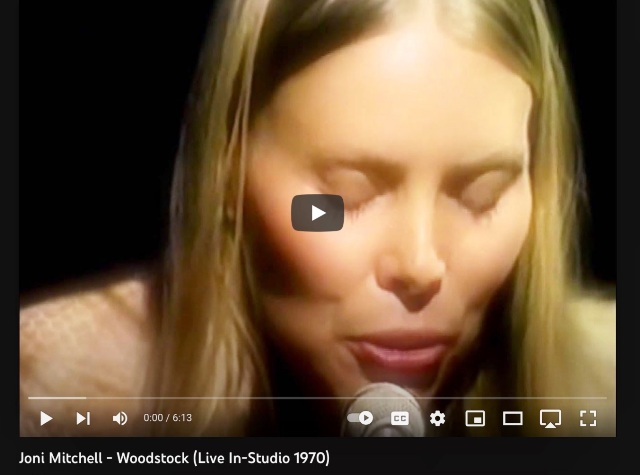


- Joni Mitchell, Live In-Studio, 1970 • https://youtu.be/T1988r4T8Wc
🌎

We Are Older Than We've Thought. We Are Born From the Stars, Yes We Are ...


New Ways of Seeing ... 2001 ... From Douglas Trumbull, a Star Friend of GreenPolicy360

~